The Anatomy of a "Show-Stopper": A Transparent Look at Event Risk Management
What happens when the main console goes dark? Take a look at the fail-safes and 'war stories' that define professional live production and save the show.
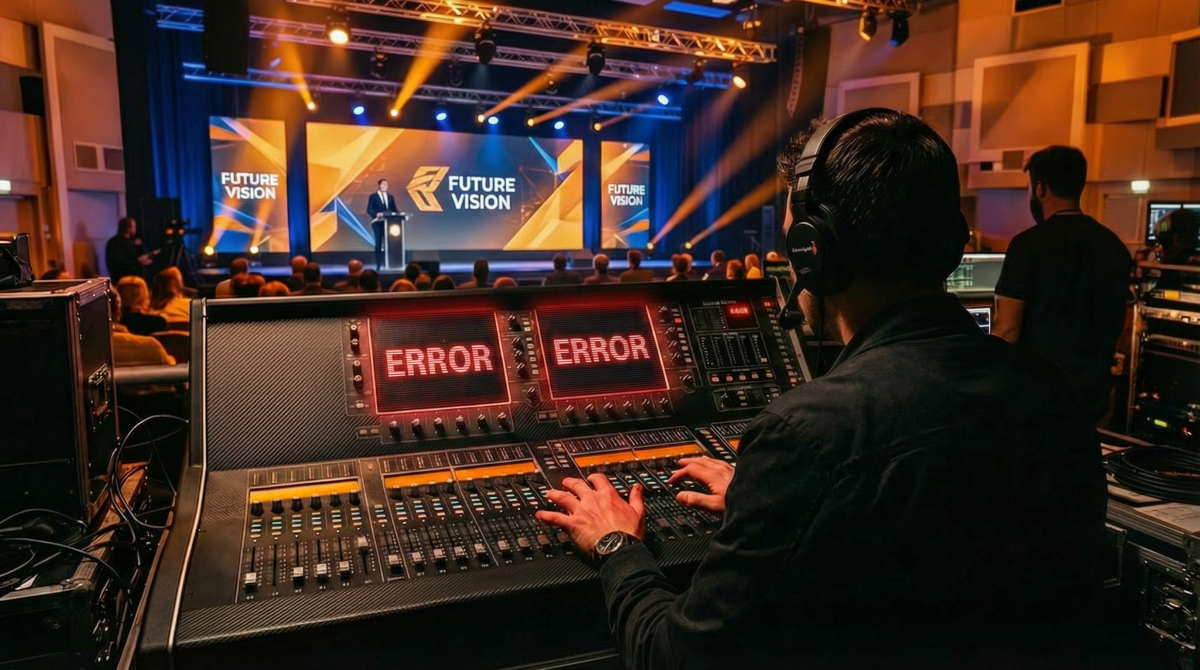
In the live event world, the term "Show-Stopper" usually refers to a standing ovation. But behind the tech table, it has a much darker meaning: the moment a critical system fails and the room goes silent.
At Outta Time Productions, we believe that the difference between a disaster and a seamless recovery isn't luck—it's preparation. Every live environment is a chaotic mix of variables, and things will go wrong. Here is a look at the three most common technical failures and the fail-safes we use to ensure the audience never notices.
1. The Total Power Blackout
It’s the nightmare scenario: a circuit is overloaded, or a venue breaker trips, and the entire stage goes dark.
The Reality: Hotels and convention centers often have unpredictable power grids. If your main switching console or your stream encoder loses power, the reboot time can be 5 to 10 minutes—a lifetime in a live show.
How We Prevent It: We utilize high-capacity Battery Backups (UPS) on all mission-critical hardware. If the venue loses power, our consoles, encoders, and primary computers stay live. This gives us the precious minutes needed to identify the breaker issue or switch to a secondary circuit without the stream ever dropping.
2. The "Frozen" Presentation
We’ve all seen it—a speaker is mid-sentence, clicks the remote, and... nothing. The slide is stuck, or worse, the laptop crashes into a blue screen.
How We Prevent It: We don't rely on a single source. We use Main and Backup Playback systems. Both laptops are loaded with the same deck and synced to the same slide. If the main machine stutters, we can switch to the backup instantly on the video switcher. To the audience, it looks like a clean transition; to us, it’s a saved show.
3. The Signal Chain Snap
In a room full of moving people, cables get stepped on, snagged, or bumped. A single loose HDMI or SDI connection can cause the main screen to flicker or the livestream to lose its feed.
How We Prevent It: Redundancy isn't just about gear; it's about Signal Flow. Whenever possible, we run dual signal paths for the most important feeds. If one cable fails, we have a secondary line already patched and ready to take over. We also perform rigorous "dry runs" during setup, testing the limits of our wireless and wired connections before the doors ever open.
Why We Tell These "War Stories"
We share these scenarios because we want event planners to know that we aren't just 'AV guys'—we are risk managers. We know that the pressure is on you to deliver a perfect event. By being intentional and working together on the plan, we create two parallel, equally exceptional experiences that unite to form one powerful event.
A professional production isn’t defined by a lack of problems—it’s defined by the audience never knowing a problem occurred.