
10 Ways to Improve Member Meetings at Southwest Florida Country Clubs
Member meetings should feel organized, easy to follow, and worth attending. These 10 improvements can help Southwest Florida country clubs communicate more clearly with their communities.
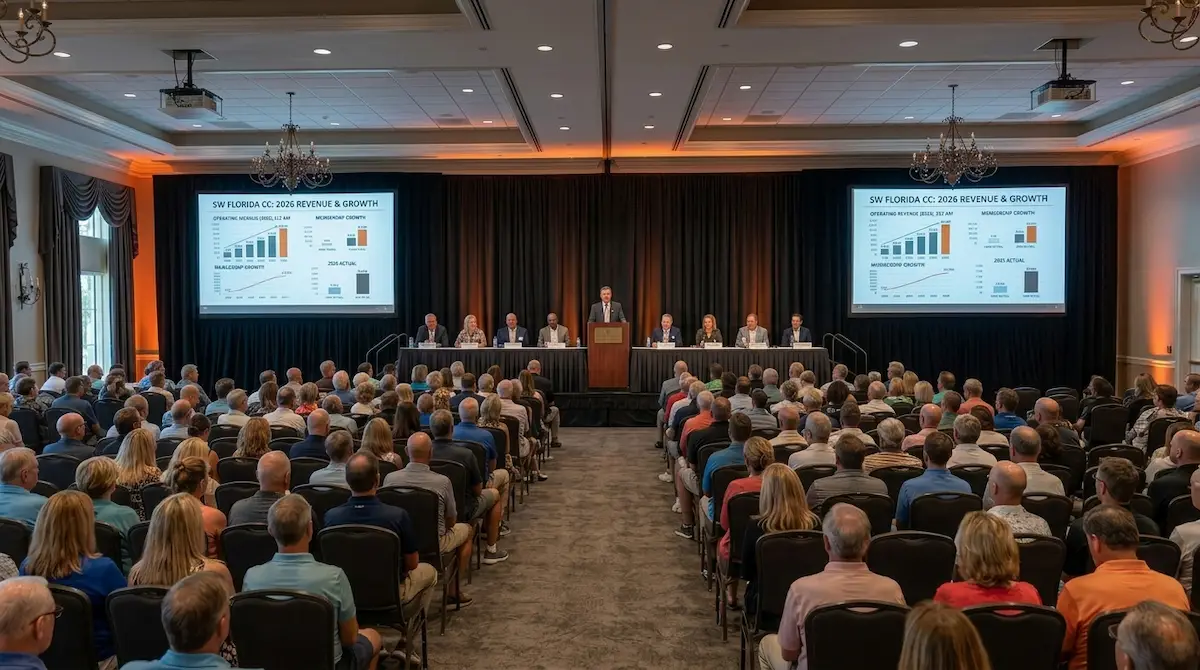
Country club member meetings may be shorter and less formal than large corporate events, but they still carry important responsibilities.
Boards and club leaders may need to explain budgets, capital projects, elections, assessments, renovations, community policies, or long-term plans. Members may arrive with detailed questions and expect the meeting to be clear, organized, and worth their time.
That does not mean the meeting needs to feel overproduced.
It means the production should support the way club meetings actually work.
In many cases, the board or panel is already seated at the front of the room. Presenters speak in sequence, follow the presentation from downstage monitors, introduce the next speaker, and move through the meeting in a practical, conversational way. The meeting may last only one or two hours, but the information being presented can still be important to the entire membership.
For country clubs and private communities across Southwest Florida, as well as clubs throughout Central and South Florida, these 10 improvements can help member meetings feel clearer, smoother, and more professional without making them unnecessarily complicated.
1. Make Clear Audio the First Priority
Members cannot engage with information they cannot hear.
Club meeting rooms are often designed for dining, social events, or entertainment rather than spoken presentations. Hard surfaces, high ceilings, long rooms, air-conditioning noise, and poor speaker placement can make speech difficult to understand.
The solution is not simply turning up the volume.
A professional audio plan considers room coverage, microphone selection, feedback control, presenter location, and how questions will be handled.
A seated board or panel may need individual microphones or carefully placed shared microphones. A podium presenter may need a dedicated microphone. Audience questions may require handheld microphones so the entire room, the recording, and any remote viewers can hear the discussion clearly.
The goal is consistent, understandable speech from every seat.
When members can hear clearly, the meeting immediately feels more organized.
2. Use Two Screens When the Room and Audience Size Support It
For many medium and larger club meetings, two screens can create a better viewing experience than one.
A single display may work in a smaller or more compact room. But in a long ballroom, wide clubhouse, divided space, or room with columns, members may have poor sightlines or need to turn away from the speakers to follow the presentation.
Two well-positioned screens can provide a more balanced view throughout the room.
The goal is not to add equipment for the sake of it.
The screen plan should be based on:
- room shape
- seating layout
- audience size
- viewing distance
- stage or panel location
- columns or architectural obstacles
- presentation content
A production partner can evaluate the room and recommend the right display setup rather than relying only on the equipment already available onsite.
3. Design Presentations for the Room, Not Just the Computer
A presentation can look clear on a laptop and still be difficult to follow in a meeting room.
Small text, crowded spreadsheets, detailed financial tables, low-contrast colors, and overloaded charts become harder to read once they are displayed across a large space.
Club presentations often include information that members need time to understand, such as budgets, capital plans, renovation renderings, voting instructions, timelines, and project updates.
That information should be prepared for the actual room and viewing distance.
Better presentation design may include:
- larger type
- stronger contrast
- simplified charts
- fewer numbers on each slide
- clear labels
- breaking dense information into several slides
- highlighting the most important figures
- testing videos and animations in advance
A production partner can review the presentation files before the meeting and identify content that may be difficult to read or display properly.
The goal is not simply to place the presentation on a screen.
The goal is to make sure members can understand it.
4. Give Presenters Downstage Monitors
Presenters should not have to turn around repeatedly to see what is being shown on the main screens.
Downstage monitors, often called DSMs or confidence monitors, allow presenters and panelists to follow the presentation while remaining engaged with the members in the room.
Depending on the meeting, a DSM can show:
- the current slide
- the next slide
- presenter notes
- a meeting timer
- remote participants
- voting or question information
This is especially useful when several board members, committee leaders, managers, consultants, or project partners are speaking during the same meeting.
Presenters can follow their section, finish their remarks, and introduce the next speaker without repeatedly checking the main display behind them.
That makes the meeting feel more natural and helps presenters stay oriented without requiring a highly scripted production.
5. Create a Clear Meeting Flow
Many club meetings do not need a detailed corporate-style run of show.
They still benefit from having a clear flow.
The meeting team should know:
- who opens the meeting
- who owns each presentation section
- when speakers change
- when videos or supporting content play
- where member questions take place
- when voting or formal business occurs
- who closes the meeting
- what happens if the agenda runs long
The presentation files may guide much of that sequence, whether the club uses one primary deck or several files from different presenters.
The important part is that the production team understands how the meeting is expected to move.
A simple meeting flow or cue sheet can help organize speaker order, presentation changes, microphones, video playback, and Q&A without making the meeting feel overly scripted.
The flow should support the club’s normal meeting style, not replace it.
6. Load and Test Every Presentation Before Members Arrive
Presentation problems often happen because files are delivered too late or are opened for the first time after the room is already filling.
The production team should receive and test the presentation materials as early as practical.
That may include:
- one main PowerPoint
- separate presentations from different speakers
- PDF documents
- videos
- architectural renderings
- financial spreadsheets
- voting instructions
- sponsor or vendor content
- remote presentation materials
Testing should confirm that fonts display correctly, videos play with sound, slide order is correct, screen layouts work, DSM feeds are visible, and presentation changes can happen smoothly.
If a presenter arrives with an updated file shortly before the meeting, the production team should have a clear process for replacing or adding it without disrupting the rest of the program.
The goal is not to restrict how the club prepares its content.
The goal is to make sure every file works before members need to see it.
7. Make Panel and Podium Microphones Easy to Use
Board members and presenters should not need to operate technical controls during the meeting.
The microphone setup should feel simple and natural.
A seated panel may use tabletop, gooseneck, boundary, or wireless microphones depending on the room and seating arrangement. A podium speaker may use a fixed microphone, wireless lavalier, or handheld microphone.
The production team should manage the technical side, including levels, muting, feedback control, and transitions between speakers.
A brief microphone check before the meeting is usually enough to make sure everyone knows where to speak and how close they should be to the microphone.
The system should support the meeting without asking presenters to think about the system.
8. Plan Member Questions as Part of the Meeting
Member questions are often one of the most important parts of a club meeting.
They can also become difficult to follow if there is no clear process.
Members may speak from their seats without a microphone. Multiple people may begin talking at once. Questions may be difficult for the board, the rest of the room, the recording, or remote viewers to hear.
A better approach uses one or more audience microphones supported by a staff member or moderator.
The moderator can recognize members, move the microphone through the room, and help keep the discussion connected to the agenda.
For larger meetings, clubs may also consider collecting questions in advance, accepting written questions, or offering a digital submission option.
The goal is not to limit participation.
It is to make participation clear, fair, and understandable to everyone following the meeting.
9. Record the Meeting and Offer Remote Access When It Adds Value
Recording is common and useful for many club meetings, especially when the program includes annual business, elections, financial updates, capital projects, policy changes, renovations, or major community announcements.
A recording can help the club:
- provide access to members who could not attend
- preserve important presentations
- document formal updates
- create shorter follow-up videos
- clarify what was communicated
- maintain an internal archive
Remote access can also help members who are traveling, living outside the area seasonally, dealing with schedule conflicts, or otherwise unable to attend in person.
A professionally managed remote option may include:
- a private viewing link
- clear room audio
- speaker and presentation video
- readable slides
- remote question submission
- controlled access for members
- recorded playback after the meeting
Remote access should be treated as part of the meeting plan, not as a laptop placed at the back of the room.
The production team should monitor what remote members are seeing and hearing so the online experience remains clear.
For meetings involving voting, formal participation, or governance requirements, the club should also confirm its governing documents and applicable procedures before choosing a remote participation method.
10. Use a Production Partner That Understands Club Meetings
A country club member meeting does not need to feel like a convention or awards show.
It does need a production team that understands the room, the membership, the presentation flow, and the pressure on club staff.
A production partner should be able to support:
- clear room audio
- panel and podium microphones
- multiple screen layouts when appropriate
- downstage monitors
- presentation management
- multiple presenter files
- video playback
- member Q&A
- recording
- remote access
- backup planning
- coordination with club staff
- discreet setup and operation
The goal is not to make the technology more noticeable.
The goal is to make the meeting easier to hear, easier to follow, and easier for the club to manage.
At Outta Time Productions, we approach club meetings as a specialized form of live production. We understand that presenters may arrive close to the meeting time, the board may follow the presentation rather than a formal script, and the event may need to fit around normal clubhouse operations.
Our job is to prepare the room, manage the technical details, support the presenters, and keep the meeting moving without making it feel larger or more complicated than it needs to be.
Better Production Supports Better Member Communication
Country club members expect leadership to communicate clearly about the issues that affect their community.
That does not mean every meeting needs elaborate staging or a large technical package.
It means the production should match the importance of the message.
For one club, that may mean stronger microphones, two properly placed screens, and DSMs for the panel. For another, it may also include remote access, recording, multiple presentation files, video playback, and a dedicated technician managing the flow.
The right solution depends on the room, the audience, the agenda, and what the club needs the meeting to accomplish.
Florida-Based Support Makes Planning Easier
Working with a Florida-based production partner can make the planning process more practical.
A local or regional team can visit the club, evaluate the meeting space, review sightlines, identify load-in challenges, test the room, and recommend the right level of support before meeting day.
It also gives the club a production partner that understands the types of spaces commonly used for member meetings, from clubhouses and dining rooms to hotel ballrooms and private community venues.
Outta Time Productions is based in Southwest Florida and supports clubs and communities throughout Southwest Florida, Central Florida, South Florida, and other Florida markets. Our services include professional audio, video, presentation support, recording, remote access, hybrid production, and complete meeting-production support.
The goal is to give clubs the benefit of a responsive Florida-based production team without limiting support to one region.
As discussed in AV Support for Country Clubs: Helping Communities Communicate Better With Members, the purpose of club AV is not simply to place equipment in a room. It is to help leadership communicate more effectively with the people they serve.
Improve the Meeting Without Making It Complicated
Better member meetings do not need to become more complicated.
The right production partner should reduce pressure on club staff, not add to it.
That means preparing the room, testing the presentation materials, supporting the speakers, managing the microphones, operating the displays, recording the meeting, monitoring remote access, and handling technical issues before they distract from the message.
Club leadership should be able to focus on the information being presented.
Club staff should be able to focus on the members.
The production team should handle the technical experience.
If your Southwest, Central, or South Florida country club or community is planning an annual meeting, board presentation, capital project update, election, town hall, or member forum, contact Outta Time Productions before the room and technical plan are finalized.
A successful club meeting does not need to feel overproduced. It needs to make every member feel informed, included, and confident in what was communicated.