
10 AV Questions to Ask a Venue Before Signing the Contract
The ballroom may look perfect, but the production rules can change the real cost and flexibility of your event. Ask these 10 AV questions before signing the venue contract.
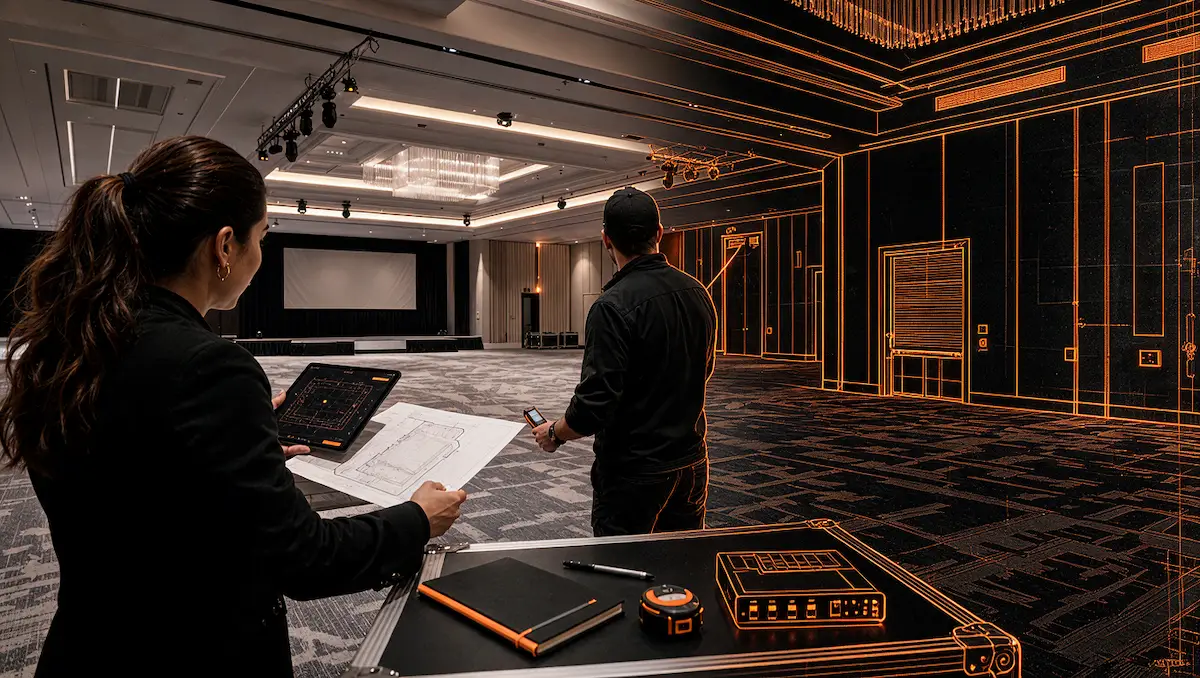
A ballroom can look perfect during a site visit.
The stage fits. The ceiling is high. The lobby works for registration. The food-and-beverage proposal is within budget.
Then production planning begins.
That is when the planner may discover that outside AV requires additional approval, internet is priced separately, the venue controls all rigging, load-in is limited to a narrow window, or the production team cannot enter the ballroom until a few hours before the first session.
None of those conditions automatically make the venue a bad choice.
They do affect the production plan.
That is why AV and production questions belong in the venue conversation before the contract is signed, not several months later when the event is already committed to the space.
At Outta Time Productions, we recommend looking beyond the ballroom itself and understanding how the venue actually operates. These 10 questions can help event planners identify technical requirements, potential costs, and operational restrictions while there is still time to compare options.
1. Can We Bring Our Own Production Partner?
Start here.
Some venues allow outside production companies with relatively few restrictions. Others have preferred providers, approval procedures, or certain services that must remain with the venue or its contracted provider.
Do not assume that “in-house AV available” means outside production is prohibited.
Also do not assume that an outside production company can simply arrive and operate without additional requirements.
Ask:
- Is outside AV permitted?
- Is the in-house provider exclusive or preferred?
- Are any services exclusive to the venue or its provider?
- Does an outside production company require approval?
- Is a certificate of insurance required?
- Are there vendor registration requirements?
- Are there fees associated with using an outside company?
- Are there services the outside production company is not permitted to provide?
If you already have a trusted production partner, involve them before the venue contract is finalized.
They may recognize technical or operational requirements that are easy to miss during a traditional venue tour.
For more on this topic, see Can You Bring Your Own AV Company to a Hotel Event?.
2. Can We Review the Venue’s Production Guidelines Before Signing?
Ask whether the venue has written production, AV, engineering, rigging, internet, or outside-vendor guidelines.
Those documents can be just as important as the ballroom floorplan.
They may explain:
- vendor requirements
- load-in procedures
- insurance requirements
- rigging policies
- internet ordering
- electrical procedures
- labor requirements
- equipment restrictions
- security procedures
- freight-elevator access
- storage rules
- ballroom access times
Getting those guidelines early gives the production team an opportunity to understand the environment before the event is contractually committed to it.
It can also help identify questions that need to be clarified in writing.
3. What Internet Service Is Available for Production?
“Free Wi-Fi” and “production internet” are not necessarily the same thing.
If the event includes livestreaming, remote presenters, hybrid participation, cloud-based presentation systems, remote production, or other internet-dependent workflows, the production team needs more detail.
Ask:
- Is wired Ethernet available in the ballroom?
- Where are the network connections located?
- What upload and download capacity is available?
- Is bandwidth shared or reserved?
- Can bandwidth be reserved specifically for production?
- Are there separate charges for wired internet?
- Can the connection be tested before the event?
- Are there firewall or network restrictions?
- Is venue IT support available during the program?
- Is a backup internet option available?
A speed test performed in the lobby during a site visit does not necessarily tell you how the production connection will perform from the technical position during the event.
Internet requirements should be evaluated based on the actual production workflow.
For a deeper look at this topic, see Why Venue Wi-Fi Is Not Always Enough for a Hybrid Event.
4. What Electrical Power Is Available in the Room?
Seeing electrical outlets around the ballroom does not tell the production team how the circuits are distributed.
Several outlets may share the same branch circuit.
For a small meeting, the existing room power may be completely adequate.
A larger production involving lighting, projection, LED walls, audio systems, video equipment, computers, cameras, networking, and technical workstations may require additional planning.
Ask:
- What electrical service is available for event production?
- Which receptacles are on separate circuits?
- Are circuits available specifically for production?
- Is higher-capacity electrical service available?
- Does the venue require its own electrician?
- Are there charges for additional electrical service?
- Who is permitted to make electrical connections?
- Are there restrictions on portable power-distribution equipment?
The event planner does not need to calculate electrical loads.
The production company and venue need enough information to coordinate the power plan before load-in.
5. What Are the Venue’s Rigging Rules?
If the event may use flown lighting, projectors, speakers, scenic elements, signs, truss, or LED walls, ask about rigging early.
Rigging rules vary by venue.
The property may require:
- approved riggers
- venue-provided rigging labor
- specific rigging hardware
- engineering documentation
- weight calculations
- advance approval
- designated rigging points
- specific motor-control procedures
The venue may also have limits on where equipment can be suspended and how much load particular structural points can support.
Ask for the venue’s rigging information before the stage design is finalized.
This becomes particularly important if an LED wall or other major scenic element is being considered.
A beautiful stage concept is not useful if the room cannot physically support it.
6. How Does Load-In and Load-Out Actually Work?
The ballroom may be easy to reach from the lobby.
The production equipment probably is not coming through the lobby.
Ask to see the actual load-in path.
Important questions include:
- Where is the loading dock?
- Can production vehicles access it directly?
- Is dock time scheduled?
- Is there a freight elevator?
- What are the elevator dimensions and weight limits?
- Are there narrow hallways or doorways?
- Are stairs involved anywhere in the route?
- How far is the dock from the ballroom?
- Are carts permitted through public areas?
- Is security required?
- Are there specific load-in hours?
- Does another event have priority on the dock?
- Where can cases be stored during the event?
A difficult load-in does not automatically eliminate a venue.
It can affect crew requirements, schedule, transportation, labor time, and ultimately cost.
A fifteen-minute equipment path and a ninety-minute equipment path are not the same production environment.
7. When Can the Production Team Access the Room?
This can have a major effect on the event.
A ballroom may technically be rented for the meeting date, but production could require access much earlier.
The team may need time for:
- equipment load-in
- staging
- lighting
- projection
- LED wall assembly
- audio setup
- cable routing
- presentation systems
- camera setup
- internet testing
- technical testing
- presenter rehearsals
Ask exactly when the room becomes available.
Do not rely only on the event start time.
If the general session begins at 8:00 a.m., but the ballroom cannot be accessed until 5:00 a.m., the production plan may be dramatically different than one that allows setup the previous afternoon.
Also ask whether there are charges associated with:
- early access
- overnight holds
- rehearsal time
- setup days
- room resets
- leaving equipment installed overnight
The production schedule should be realistic before the venue schedule is locked.
8. Are There Required Labor or House Personnel?
Some venues, convention centers, and event properties have specific labor requirements.
Depending on the venue and location, certain work may need to be performed or supervised by designated personnel.
That can potentially include:
- rigging
- electrical work
- internet services
- dock operations
- material handling
- security
- engineering
- venue supervision
Ask which services require venue personnel and which may be handled by the production company.
Also ask:
- What are the labor minimums?
- Are there overtime rules?
- Are there minimum call lengths?
- Are there evening or weekend premiums?
- Is a venue supervisor required when outside AV is used?
- Are there specific break or scheduling requirements?
These are not reasons to avoid a venue.
They are costs and scheduling requirements that should be understood before the event budget is finalized.
9. What Existing AV Equipment Is Actually Included?
A venue may advertise built-in screens, projectors, speakers, lighting, microphones, or other technology.
Find out exactly what that means.
Ask:
- What equipment is permanently installed?
- Is it included in the room rental?
- Is there an additional fee to use it?
- Who operates it?
- Can an outside production company connect to it?
- What signal connections are available?
- What resolution do the displays support?
- Is the system appropriate for the expected audience size?
- Can the equipment be tested during a site visit?
- Is technical support included?
Existing venue technology can sometimes be useful and reduce the amount of equipment that needs to be brought into the room.
It should still be evaluated based on the event requirements.
A built-in projector is not automatically the correct projector.
A ceiling speaker system is not automatically the right audio system.
The production plan should determine whether existing equipment helps solve the event, not simply whether it exists.
10. What Production-Related Costs Are Not Included in the Room Rate?
This may be the most important budgeting question.
The ballroom rental is only one part of the venue cost.
Before comparing venues, ask about production-related charges that could appear later.
Possible items may include:
- internet
- electrical service
- rigging
- rigging labor
- venue engineering
- outside-vendor fees
- dock access
- security
- storage
- freight handling
- overnight equipment holds
- additional setup days
- rehearsal access
- room resets
- required venue technicians
- required supervisory personnel
Not every venue charges for all of these.
The point is to find out what applies to your event.
A venue with a higher room rate could ultimately be easier and less expensive to produce in than a venue with a lower room rate but significant production restrictions and additional service charges.
Compare the complete event environment, not only the ballroom rental.
Bonus Tip: Bring Your Production Partner to the Site Visit
One of the easiest ways to uncover these issues early is to include the production company during venue selection.
An event planner may naturally focus on:
- room capacity
- food and beverage
- guest rooms
- registration
- décor
- attendee flow
- meeting schedules
A production team is looking at the same room differently.
They may notice:
- projector throw limitations
- poor screen sightlines
- ceiling restrictions
- insufficient backstage depth
- electrical limitations
- cable-routing challenges
- camera positions
- loading access
- control-position locations
- internet requirements
- rigging limitations
Neither perspective replaces the other.
Together, they provide a more complete picture of whether the venue actually supports the event.
The Best Time to Solve Venue Problems Is Before the Contract
Most venue-production challenges can be managed when they are identified early.
The problem is usually not that a venue has rules.
The problem is discovering those rules after the room, schedule, budget, and production design have already been committed.
Before signing, make sure you understand:
- Whether outside production is permitted.
- What the venue’s production rules require.
- What internet service is available.
- What electrical service is available.
- How rigging works.
- How equipment gets into the room.
- When production can access the space.
- What labor or house personnel are required.
- What existing AV equipment can actually be used.
- What additional production costs may apply.
Knowing these questions can help you evaluate a venue more carefully and avoid surprises later.
But it does not mean the event planner needs to become an expert in internet infrastructure, electrical distribution, rigging, loading docks, projection, or venue labor rules.
Your Production Partner Should Help Carry This Process
When Outta Time Productions is involved early, we help work through these production details with you.
We review the event requirements, identify the information we need from the venue, ask the technical questions, coordinate with the appropriate venue departments and providers, and incorporate those answers into the production plan.
That may mean working directly with venue engineering on power, reviewing internet requirements with the property’s IT team, confirming rigging procedures, evaluating load-in access, checking room dimensions and sightlines, or determining whether existing venue equipment fits the production.
Some services may ultimately be provided by the venue or another qualified provider. Our role is to make sure those pieces are identified, coordinated, and accounted for as part of the complete production.
You should not have to discover halfway through planning that the LED wall cannot be rigged where expected, the production team cannot access the ballroom until early that morning, or the internet service needed for the hybrid program was never ordered.
Those are the kinds of questions that should be answered before they become problems.
Outta Time Productions works with planners, venues, agencies, and internal teams to align the room, content, crew, schedule, and technical requirements before show day.
The checklist in this article can help you know what to look for when evaluating a venue.
When you work with us, you do not have to carry that checklist alone.
If you are comparing venues for a corporate meeting, general session, conference, leadership event, or hybrid production, Begin Planning early. We can help evaluate the production requirements before the venue and technical plan are locked.
The right venue is more than a room that fits the audience. With the right production partner involved early, the technical details can be identified, coordinated, and planned before they become your problem on show day.