
LED Wall vs. Projection: Which Is Better for Your Corporate Event?
LED walls and projection can both deliver excellent corporate event visuals. The right choice depends on room conditions, audience distance, content, cameras, power, structure, and budget.
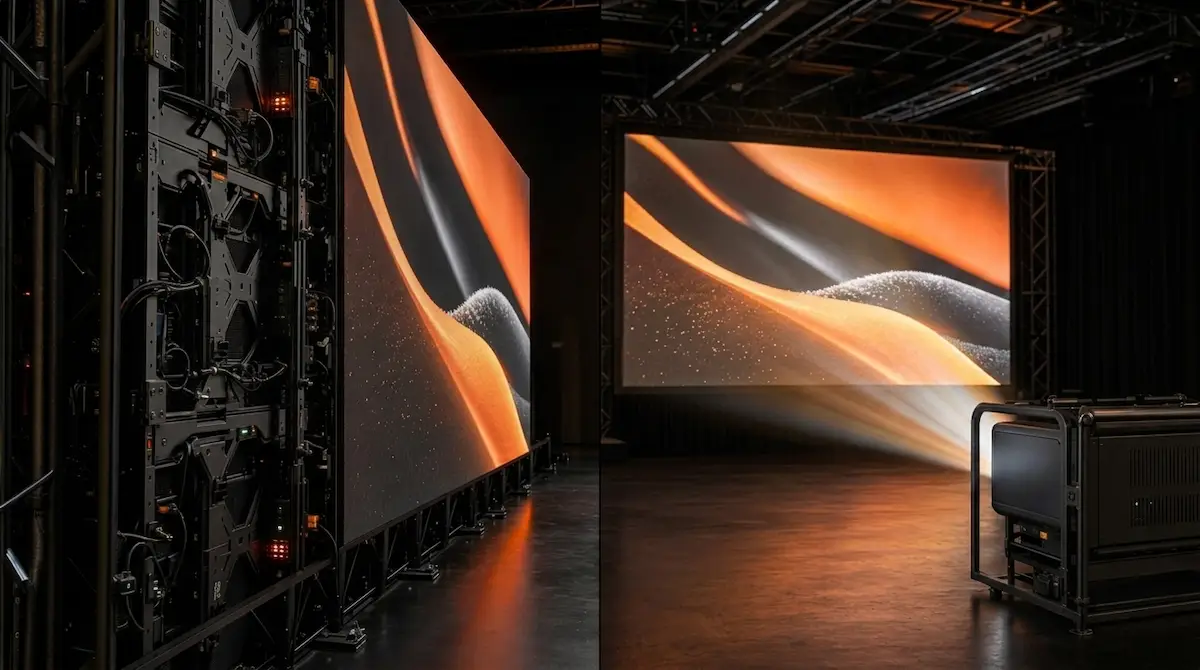
When planning a corporate event, one of the most visible technical decisions is how the audience will see the content.
For years, projection has been a standard solution for general sessions, conferences, meetings, and corporate presentations. Direct-view LED walls have become increasingly common as another option, offering bright, modular displays that can become part of the visual design of the room.
Both technologies can produce excellent results.
Neither is automatically better.
The right choice depends on the room, audience, presentation content, lighting conditions, camera requirements, available space, structural limitations, electrical requirements, and budget.
At Outta Time Productions, we approach the decision by starting with what the audience needs to see and how the event needs to operate. The display technology should support those requirements rather than being selected simply because one option looks more impressive on a proposal.
How Projection Works
Professional event projection uses a projector to send an image onto a projection surface.
Depending on the room and production design, the projector may be positioned in front of the screen or behind it.
The required distance between the projector and screen depends on the projector, lens, image size, and room configuration.
Professional large-venue projectors are available with different lens options that allow production teams to work with short, medium, and long throw distances.
Projection remains widely used because it can create large images without requiring the entire display surface to contain electronic pixels.
A large projection screen can therefore provide substantial image area with a relatively simple physical display structure.
That can make projection especially practical when the room provides the necessary throw distance, lighting conditions, and screen placement.
How a Direct-View LED Wall Works
A direct-view LED wall creates the image directly on the display surface.
Instead of a projector sending light toward a screen, thousands or millions of individual LED pixels emit the image from the wall itself.
The wall is assembled from modular panels or cabinets.
Those panels can be combined into different widths, heights, and configurations depending on the product and structural system being used.
Because there is no projector beam traveling across the room, LED eliminates the traditional projector-to-screen throw path.
That can be valuable in rooms where projection placement is difficult or where the production design needs more flexibility around the display.
Ambient Light Changes the Conversation
One of the most important differences between the technologies is how they behave in brighter environments.
Projection works by reflecting light from a screen toward the audience.
Ambient light falling on that screen can reduce perceived contrast.
That does not mean projection cannot work in a bright ballroom or conference room.
Professional projectors are available with very high light output, and the production team can also consider screen material, image size, projector brightness, room lighting, and window control when designing the system.
The key is engineering enough image brightness and contrast for the actual environment.
Direct-view LED creates its own light at the display surface.
That gives LED an advantage in many environments with significant ambient light because the display can maintain strong brightness and contrast without relying on reflected projection light.
This can make LED particularly attractive for:
- rooms with significant daylight
- bright exhibit environments
- corporate stages that cannot be kept relatively dark
- events using substantial scenic or broadcast lighting
- locations where maintaining a high-contrast projected image would be difficult
But even LED is not completely immune to its environment.
Brightness still needs to be appropriate for the room, and an unnecessarily bright LED wall can become uncomfortable for attendees or create challenges for cameras.
More brightness is not automatically better.
Lumens and Nits Are Not the Same Measurement
Comparing projector and LED specifications can become confusing because the two technologies are generally described using different brightness measurements.
Projector light output is commonly specified in lumens.
Direct-view LED displays are commonly specified in nits, which describe luminance at the display surface.
Those numbers should not be compared directly.
A 10,000-lumen projector and a 1,000-nit LED wall are not simply two values on the same scale.
The final result depends on the complete display system, including image area, screen characteristics, ambient light, viewing distance, content, and the technology being used.
Rather than comparing specification numbers alone, planners should ask whether the proposed display will provide sufficient visibility and contrast in the actual room.
LED Pixel Pitch Matters
One of the most important specifications when selecting an LED wall is pixel pitch.
Pixel pitch describes the distance between neighboring LED pixels, generally measured in millimeters.
A smaller pixel pitch places the pixels closer together.
That increases pixel density and generally allows the audience to view the display from a shorter distance before individual pixels become noticeable.
A larger pixel pitch can be appropriate when the audience is farther away.
This is why the same LED product is not ideal for every event.
A large ballroom where the first audience row is twenty or thirty feet from the screen may tolerate a different pixel pitch than an executive event where attendees are sitting only a few feet from the display.
Pixel pitch also affects the total native resolution of the wall.
A Large LED Wall Is Not Automatically 4K
This is an important distinction for planners and content teams.
The physical size of an LED wall does not automatically determine its resolution.
A very large LED wall can still have a relatively modest native pixel count if the pixel pitch is large.
Conversely, a smaller wall using a very fine pixel pitch can contain a much higher pixel density.
The final native resolution depends on:
- pixel pitch
- individual panel resolution
- number of panels
- wall dimensions
- panel orientation and configuration
For that reason, the production team should provide the final LED raster dimensions to the content team before graphics are finalized.
Content can be scaled by a video processor, but designing important graphics around the actual display canvas generally produces a more predictable result.
Projection Handles Resolution Differently
With projection, the projector itself has a defined imaging resolution.
The physical image can then be made larger or smaller within the optical and brightness limits of the system without physically adding more pixels to the screen.
A 4K projector, for example, still has the same native imaging resolution whether the projected image is twelve feet wide or thirty feet wide.
What changes is how those pixels are distributed across the larger surface and how much light is available for that image area.
This is another reason display size should not be considered independently from viewing distance.
The audience needs enough image detail to read the content from where they are actually sitting.
Room Depth Can Favor One Technology
Projection requires space for an optical path between the projector and screen.
The exact distance depends on the lens and screen size.
Front projection may require a projector position somewhere in the room or overhead.
Rear projection moves the projector behind the screen, which can eliminate shadows from people walking in front of the image but requires enough space behind the screen for the projection system.
LED does not require that throw distance.
The wall itself occupies physical depth, and the structure supporting it needs space, but there is no projector beam extending across the room.
That can be especially useful when:
- the ballroom is shallow
- backstage depth is limited
- ceiling height restricts projector placement
- sightlines make projector positions difficult
- scenic design surrounds the display
- presenters need to move directly in front of the image
Room geometry can sometimes make the decision before brightness or aesthetics even enter the conversation.
Projection Still Offers Significant Flexibility
LED is often described as the flexible display technology because modular panels can create different screen dimensions.
That is true, but projection can also be highly flexible.
Multiple projectors can be blended to create very wide images, panoramic canvases, or unusually shaped visual environments.
Projection mapping can place content across architectural surfaces and scenic elements.
The difference is that more complex projection designs may require additional projectors, processing, alignment, and calibration.
For a conventional corporate presentation, a standard projection screen may be the simplest solution.
For a highly customized visual environment, either technology may be capable of producing the desired result.
The production team needs to determine which approach accomplishes it more efficiently.
LED Can Become Part of the Scenic Design
Because an LED wall is a physical illuminated surface, it can function as both a display and a major scenic element.
Instead of building a traditional stage with projection screens added to it, the LED canvas can become part of the architecture of the stage.
That may allow designers to create:
- wide panoramic backgrounds
- center displays
- vertical display columns
- multiple connected canvases
- large branded environments
- scenic surfaces containing motion graphics
- unusual aspect ratios
This can be particularly effective for product launches, sales meetings, awards programs, leadership conferences, and events where the visual identity of the stage is important.
It does not mean every event needs an LED wall.
Sometimes a clean projection screen is exactly what the program requires.
Projection Can Be Extremely Effective for Traditional Presentations
PowerPoint presentations, financial charts, videos, keynote presentations, and standard 16:9 corporate content can work extremely well with professional projection.
When the room supports the necessary throw distance and lighting conditions, projection can provide a very large image without requiring a modular electronic wall.
This is one reason it remains a strong choice for:
- general sessions
- educational conferences
- annual meetings
- leadership programs
- association events
- breakout rooms
- training programs
- presentation-heavy corporate meetings
The question is not whether projection is older technology.
The question is whether it solves the event requirement well.
Modern professional laser projectors can provide high brightness, high resolution, flexible lenses, and reliable performance for large venues.
Think About What the Audience Is Actually Looking At
The type of content matters.
Corporate presentations frequently contain:
- spreadsheets
- financial information
- small labels
- charts
- architectural renderings
- product interfaces
- timelines
- dashboards
- detailed diagrams
Those materials require different display considerations than a stage using large photographs and motion graphics.
A very wide LED wall may look dramatic, but placing a standard presentation in the center of it may leave large unused areas unless the content has been designed for the canvas.
Likewise, a beautiful projection screen will not help if the presentation contains text that is too small for the audience viewing distance.
The display and content plan should be developed together.
Cameras Add Another Layer to the Decision
Events using IMAG, livestreaming, recording, or broadcast cameras should consider how the display appears on camera as well as to the audience.
Modern event-grade LED systems can perform very well on camera.
However, LED displays can require attention to:
- pixel pitch
- refresh rate
- scan behavior
- display processing
- camera shutter settings
- camera-to-wall distance
- exposure
- brightness
- synchronization in more advanced workflows
Under some combinations of LED panels and camera settings, unwanted artifacts such as visible scan patterns, flicker, or moiré can appear.
Higher-performance LED products are specifically designed with on-camera performance in mind, but the system still needs to be tested with the cameras being used.
For a corporate event with significant IMAG or recording, the production team should treat the camera and LED system as one visual workflow rather than two unrelated departments.
Projection Also Needs Camera Consideration
Projected images can create their own camera challenges.
The production team needs to balance projector brightness, stage lighting, camera exposure, screen content, and presenter lighting.
If the camera exposure is optimized only for the presenter, the projected content may appear too bright or too dark.
If the screen is adjusted only for the room, it may not reproduce correctly on camera.
The same principle applies to both technologies.
A display that looks excellent to the eye still needs to be evaluated through the camera system when recording or IMAG matters.
Power Requirements Should Be Reviewed Early
LED walls are assembled from multiple powered panels.
As the wall becomes larger, the electrical load associated with those panels, processors, and related equipment increases.
Projection concentrates much of the display power into one or more projectors rather than distributing it across an illuminated wall.
Neither system should be assumed to have trivial power requirements.
A large LED wall can require substantial electrical distribution.
A high-output projector system can also require significant power.
The exact requirements depend on the products, quantity, brightness settings, and configuration.
The production team should calculate the actual electrical load rather than estimating it from the physical size of the display.
Power should be coordinated with the venue before load-in.
LED Has Structural Requirements Too
An LED wall is not simply a collection of screens stacked together.
Professional event LED systems require appropriate structural support.
Depending on the production, the wall may be:
- ground supported
- flown from rigging
- mounted within a scenic structure
- supported by a manufacturer-approved system
The total weight can become significant because the wall includes multiple cabinets, structural hardware, cabling, processing equipment, and supporting components.
Rigging capacity, floor loading, wall height, wind exposure for outdoor installations, and venue rules may all affect the design.
Projection also has structural requirements for screens and projectors, but the loads and locations are different.
The venue and production team should evaluate the complete system rather than comparing only the visible display surfaces.
Setup Time Can Be Different
A projection system may involve:
- screen assembly
- projector placement
- lens selection
- alignment
- focusing
- color matching
- signal testing
An LED wall may involve:
- structural assembly
- installing multiple cabinets
- power distribution
- data cabling
- processor configuration
- panel alignment
- color and brightness calibration
- testing individual modules
Neither technology automatically installs faster.
The time depends on the size and complexity of the system.
A small projection setup may be considerably simpler than a large LED wall.
A preconfigured LED system may be more practical than trying to engineer a complex multi-projector blend.
This is why load-in schedules should be based on the actual production rather than a general assumption about the technology.
Budget Should Be Evaluated as a Complete System
LED and projection should not be compared using only the price of the display equipment.
The full system may include:
- display hardware
- processors
- lenses
- screens
- structural support
- rigging
- electrical distribution
- signal distribution
- labor
- transportation
- setup time
- content preparation
- backup equipment
Projection can be a strong value for conventional large-format corporate displays when the room is well suited for it.
LED may justify additional production cost when its brightness, modularity, reduced throw-space requirements, scenic integration, or visual impact solves a problem the event actually has.
The appropriate choice should come from the entire production plan.
When Projection Often Makes Sense
Projection deserves strong consideration when:
- the room allows an appropriate projector position
- ambient light can be reasonably controlled
- the event primarily uses standard presentation content
- a traditional 16:9 display works well
- the desired image is large but scenic integration is limited
- the production needs a practical large-format display solution
- the screen does not need to be a major scenic feature
Projection should not be treated as the budget option by default.
A properly engineered projection system can be a premium visual solution.
When LED Often Makes Sense
Direct-view LED deserves strong consideration when:
- ambient light is difficult to control
- the display is central to the scenic design
- the room does not provide a practical projection throw
- unusual display dimensions are desired
- the stage requires a very bright visual canvas
- presenters will regularly stand directly in front of the display
- multiple scenic display surfaces are part of the design
- the production is willing to support the additional structural, processing, electrical, and labor requirements
LED should not be selected simply because it is newer or visually impressive.
It should solve a production or design requirement.
Sometimes the Best Answer Is Both
LED and projection do not have to be mutually exclusive.
A large general session may use a central LED wall with projected side screens.
Projection may provide presentation support while LED creates a scenic background.
Separate projection screens may provide IMAG while an LED canvas carries branding and motion graphics.
Different technologies can be assigned different jobs.
The audience does not care whether every display uses the same technology.
They care whether they can clearly see the information.
Start With the Room, Not the Screen
The display decision should begin with a few practical questions:
- How large is the audience?
- How far away is the closest viewer?
- How far away is the farthest viewer?
- What type of content will be shown?
- Can room lighting be controlled?
- How much daylight enters the space?
- Where can projectors physically be positioned?
- Is there sufficient backstage depth?
- What rigging or ground-support options exist?
- Will the display appear prominently on camera?
- What electrical service is available?
- How much setup time is available?
- What role does the display play in the scenic design?
- What budget has been allocated to the visual system?
Once those questions are answered, LED versus projection becomes a much more practical decision.
Choose the Technology That Solves the Event
There is no universal winner between LED and projection.
A well-designed projection system can outperform a poorly specified LED wall.
A properly selected LED wall can solve room and lighting problems that make projection unnecessarily difficult.
The technology itself is only part of the result.
Pixel pitch, projector brightness, lenses, viewing distance, processing, content design, cameras, rigging, power, setup, and technical operation all matter.
Outta Time Productions approaches display design as part of the complete live event production plan. The room, audience, presentation content, camera system, and event objectives should determine the technology rather than the other way around.
For planners comparing equipment proposals, The Difference Between a Vendor and a Production Partner also explains why understanding the complete production problem matters more than comparing individual equipment line items.
If you are planning a corporate general session, leadership meeting, conference, product launch, or presentation-driven event and are deciding between projection and LED, Begin Planning before the room and display design are finalized.
The best display is not the one with the newest technology. It is the one that lets every person in the room clearly see what matters.