
Why Event Production Planning Should Start Before the Contract Is Signed
A production proposal can look complete while important technical questions are still unanswered. Learn why involving production early can protect budgets, expectations, timelines, and client relationships.
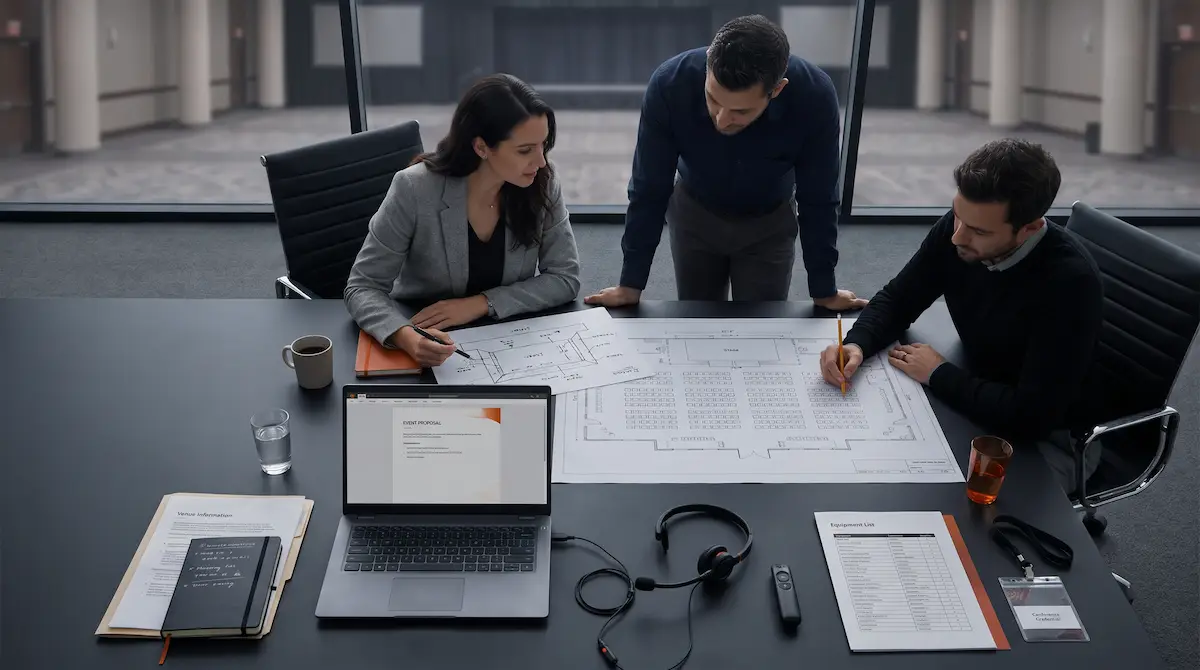
A corporate event proposal can look complete on paper.
LED wall.
Cameras.
Presentation support.
Audio.
Recording or livestreaming.
Crew.
The client approves the scope, the contract is signed, and everyone moves forward.
Then the production team begins asking questions.
Where is the LED wall actually going?
What power is available?
How much time is available for load-in?
Where can cameras be positioned without affecting audience sightlines?
What presentation sources need to be supported?
What does the venue provide?
What does the venue require?
Suddenly, a project that looked finished is still being designed.
That is why technical production planning should begin before the major expectations, budget, and scope are locked.
A Proposal Is Not the Same as a Production Plan
A proposal describes what is being provided.
A production plan explains how it will actually work.
Those are not always the same thing.
A large display, for example, affects more than what appears onstage. It may affect room layout, power, labor, content preparation, camera positions, sightlines, installation time, and venue requirements.
A livestream may involve more than adding an encoder and an internet connection. The team may also need to consider audio routing, network access, platform requirements, remote presenters, captions, recording, testing, and backup options.
None of those details are reasons to make the event unnecessarily complicated.
They are reasons to ask better questions early.
Problems Are Easier to Solve Before the Client Says Yes
An overlooked requirement discovered during planning is usually manageable.
The same requirement discovered during setup can become expensive.
Maybe additional equipment is needed.
Maybe another technician has to be added.
Maybe the venue needs to provide electrical or network services that were never ordered.
Maybe the room layout has to change.
Maybe a piece of the original concept is no longer practical.
The problem is not always that something changed.
Live events change constantly.
The problem is when something fundamental was never identified in the first place.
That can put pressure on the budget, the crew, the planner, and the client relationship all at once.
Technical Knowledge Should Be Part of the Sales Conversation
This does not mean every person involved in business development needs to be a video engineer, audio engineer, or technical director.
It means the technical side of the project should be connected to the client conversation early enough to influence the solution.
Some of the most useful questions may be simple:
- What is the event trying to accomplish?
- What does the room look like?
- How many attendees are expected?
- What does the audience need to see and hear?
- How many presenters and presentation sources are involved?
- Will anything be recorded or streamed?
- What are the load-in and rehearsal windows?
- What does the venue provide?
- Are there power, rigging, labor, or network requirements?
- What parts of the event cannot afford a single point of failure?
Those questions help turn an idea into something that can actually be produced.
Better Technical Planning Can Protect the Budget
Bringing production into the conversation early does not automatically mean adding more equipment.
Sometimes it means removing equipment.
A production team may determine that a smaller display configuration works better for the room.
Existing infrastructure may be usable.
A planned feature may not add enough value to justify its cost.
Or spending more in one important area may prevent a much more expensive problem later.
The goal should not be to build the largest possible technical package.
It should be to build the right one.
That means understanding what the event needs before the budget is divided among solutions that may or may not support the actual objective.
The Venue Needs to Be Part of the Conversation Too
Many production surprises are not really equipment problems.
They are coordination problems.
The venue may control:
- electrical service
- rigging
- internet access
- loading areas
- room access times
- house labor
- fire and safety requirements
- existing AV infrastructure
Those requirements can affect both the production design and the cost.
That is why we recommend asking technical questions before the venue agreement is finalized whenever possible.
Our guide to 10 AV Questions to Ask a Venue Before Signing the Contract covers several of those conversations in more detail.
The production partner does not need to replace the venue team.
But someone should be connecting the venue requirements to the production plan.
The Client Should Not Discover the Plan During Setup
By the time equipment begins arriving onsite, the major production questions should already have answers.
The planner should understand what is being built.
The venue should know what production needs.
Presenters should know how their content will be handled.
The production crew should understand the program they are expected to execute.
A technical rehearsal should confirm the plan, not become the first time the team discovers how the event is supposed to work.
That is one reason technical rehearsals matter.
There will still be adjustments.
A presenter may arrive with a new deck.
A schedule may change.
A session may run long.
Those are normal live-event challenges.
They are much easier to manage when the underlying production plan is already solid.
Good Planning Protects More Than the Show
Poor alignment between the proposal and the production does not only create technical problems.
It can affect trust.
From the client's perspective, it does not matter whether a problem originated in sales, production, the venue, or another department.
They simply know that something they thought was handled suddenly is not.
That can lead to uncomfortable conversations about additional costs, changed expectations, or compromises that were never discussed during the proposal process.
When production knowledge is involved earlier, those conversations can happen before they become problems.
Expectations become clearer.
Budgets become more realistic.
Crews receive better information.
And the client has more confidence that the company proposing the event also understands how to deliver it.
The Proposal Should Reflect the Reality of the Show
A strong production proposal should do more than list equipment.
It should be built around an understanding of the room, the audience, the presenters, the schedule, the venue, and the objective of the event.
That is why Outta Time Productions approaches production planning as part of the project from the beginning.
We work with planners, venues, presenters, and internal teams to identify requirements early, ask the technical questions that matter, and turn those answers into a production plan that can actually be executed.
The goal is not to make planning more complicated.
It is to prevent show day from becoming the moment when everyone discovers what should have been discussed weeks earlier.
The best time to solve a production problem is before it becomes a show-site problem.