
Satellite Events: Connecting Multiple Locations as One Live Experience
Satellite events connect audiences in multiple physical locations through one coordinated program. Learn how planning, production, and local experiences bring every site together.
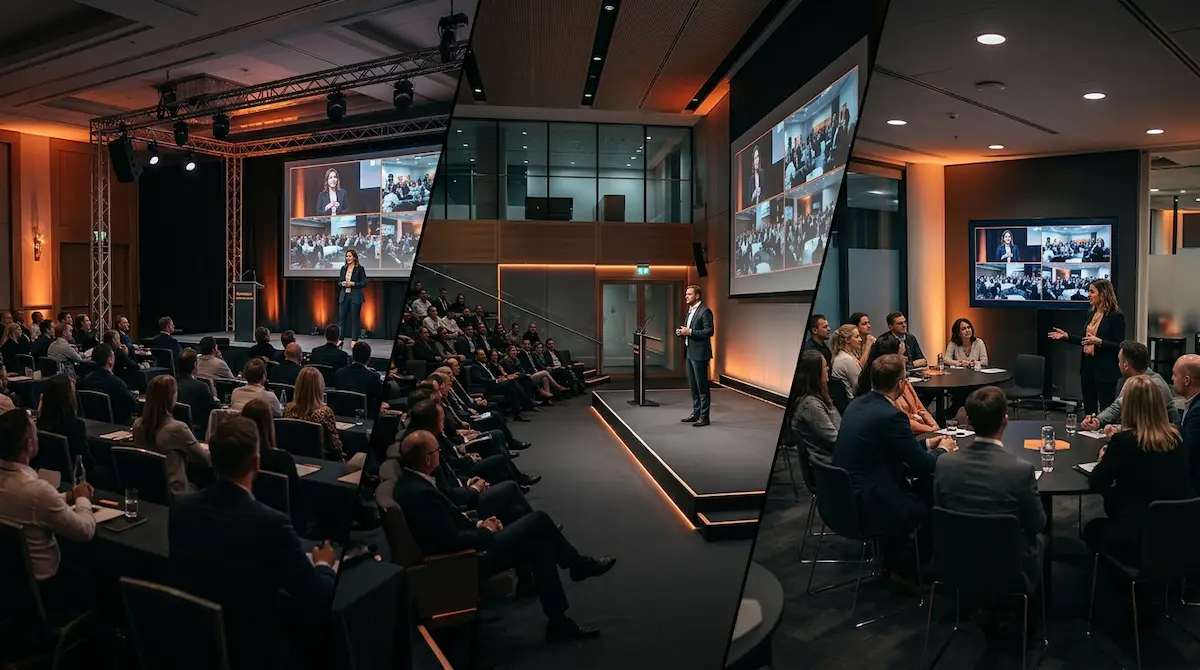
A company-wide event no longer has to happen in one ballroom.
Organizations with regional offices, distributed teams, national customers, or international operations can now bring people together across several physical locations while still creating one coordinated live experience.
That is the idea behind a satellite event.
Instead of asking every attendee to travel to one city, a company may host a main stage at headquarters while employees gather in regional offices. A product launch may begin in one market and include live contributions from several others. A sales kickoff may connect teams across time zones through shared keynotes, local sessions, and live interaction between locations.
Each site is a real event.
The technology connects the rooms, but the success of the format depends on much more than sending a livestream from one venue to another.
At Outta Time Productions, we view satellite events as a combination of live event production, hybrid technology, venue coordination, local audience experience, and centralized show management. The locations may be separate, but the event still needs to feel like one show.
What Is a Satellite Event?
The term “satellite event” can be used in different ways across the events industry. In this article, it refers to one coordinated program taking place across two or more physical locations.
The locations are connected through live video, audio, shared presentations, and one overall production plan. There may be a main location where most of the programming originates, with several regional sites receiving and contributing to the program. Other events may distribute the content more evenly, allowing different cities or offices to take the lead at different moments.
This is different from a standard livestream.
A livestream usually sends one event to people watching remotely. A satellite event connects several in-person audiences, each gathered in its own room, while still giving them a shared experience.
That difference matters.
The people at each site are not simply remote viewers. They are attendees participating in a local event that is part of something larger.
Why Companies Use Satellite Events
Satellite events can help companies bring people together without requiring every attendee to travel to the same destination.
That can be useful for organizations with regional sales teams, multiple offices, distributed employees, national customer communities, or international operations.
The format can support corporate town halls, sales kickoffs, product launches, leadership meetings, training programs, customer events, awards programs, and association gatherings.
Travel reduction may be one benefit, but it should not be the only reason to choose the format.
A satellite event still requires venues, local production support, reliable connectivity, rehearsals, show calling, and coordination across every site. In some cases, it may be more complex than producing one large event.
The strongest reason to use the format is that it can create a better experience for a distributed audience.
People can gather locally, interact with colleagues, participate in discussions, and still feel connected to a larger company-wide moment.
The Local Experience Is What Makes the Format Work
One of the biggest risks with satellite events is creating one main event and several secondary rooms.
If the headquarters stage receives all the attention while regional audiences only watch a screen, those locations can quickly feel like overflow spaces.
That weakens the value of gathering in person.
Each site should offer something that cannot be experienced by watching alone from a laptop. That may include a local host, regional leadership, facilitated discussions, networking, workshops, recognition moments, local Q&A, meals, or market-specific content.
The shared program connects the organization.
The local experience gives people a reason to attend.
A successful satellite event should make every location feel intentional, not secondary.
One Show, Multiple Rooms
Although the event takes place in several locations, it should still operate from one central production plan.
The program needs a master run of show that defines when locations are receiving shared content, when they are operating locally, and when they are contributing back to the larger event.
Those transitions need to be called and rehearsed just like transitions in a single ballroom.
A regional site may begin with local networking, join the main keynote, move into a local breakout, and return later for a company-wide closing. Another site may contribute a panelist, award recipient, or customer story to the shared program.
The audience should experience those changes as part of one deliberate show.
Behind the scenes, that requires clear ownership.
A central show caller may coordinate the full program while local producers or stage managers manage each individual room. The central team needs to know when every site is ready, what each audience is seeing, and how timing changes affect the larger schedule.
The local teams need to know when they are live, when they are receiving the shared feed, when they return to local programming, and who makes the final decision if something changes.
Without that structure, a multi-location event can quickly become several disconnected meetings.
Every Site Needs Local Production Support
Technology may connect the locations, but people still operate the event.
Each site needs someone who understands the local venue and the larger program.
The size of the local team depends on the event. A major regional venue may need audio, video, camera, presentation, and stage management support. A smaller office gathering may use a more compact crew.
What matters is that someone onsite owns the experience.
The local team should understand the room, the speakers, the screens, the audio system, the connection to central production, and the backup plan.
They also need a direct communication path to the central team.
Small venue issues can become network-wide problems if no one is responsible for resolving them locally.
A production partner helps define what level of support each site needs rather than assuming every location should use the same crew or equipment package.
Audio Is What Makes the Connection Feel Natural
Audio is one of the most important parts of a satellite event.
Every audience needs to hear the shared program clearly. If locations are interacting, the speakers also need to hear one another without feedback, echo, delay, or confusing audio returns.
A keynote sent from one location to several others may be relatively straightforward.
A live conversation between executives in three cities is more complicated.
The production plan may need separate audio mixes for the room and the transmission feed, clean microphone routing, playback audio, audience question microphones, remote audio returns, and monitoring at both the central and local sites.
Two-way conversations may also require mix-minus routing so speakers do not hear delayed versions of themselves.
The technical system should support the conversation without making the technology noticeable.
When the audio is handled well, the locations feel connected.
When it is not, the distance becomes obvious.
Cameras Help Separate Rooms Feel Like One Event
Cameras do more than record what is happening.
They help each audience understand who is speaking, where to focus, and how other locations are reacting.
A single locked-off wide shot may show the stage, but it may not create much connection. Depending on the program, the event may benefit from closer speaker shots, panel coverage, audience reactions, local host positions, or room-wide views that establish each location.
The goal is not to make every venue look identical.
The goal is to make every venue feel like it belongs to the same event.
Camera framing, lighting, stage positioning, and screen content should be consistent enough that moving between locations feels intentional.
If one site appears polished and well lit while another looks dark, distant, or poorly framed, the event can feel disconnected even when the technology is working.
Screens Become Windows Between Locations
In a satellite event, screens do more than display slides.
They connect rooms.
The size, position, and brightness of those screens affect whether another location feels present or distant.
A speaker appearing on a small side screen may feel secondary. A well-positioned display with clean camera framing can make the interaction feel much more natural.
The production plan should consider how speakers, slides, remote locations, and shared graphics will appear together.
Some moments may need a full-screen speaker view. Others may work better with a picture-in-picture layout that keeps slides visible. Audience questions between locations may require a different screen treatment than a keynote presentation.
These decisions should be made before show day.
The screen layout is part of the experience, not just a technical detail.
Internet Planning Has to Happen at Every Site
Every location needs a reliable connection into the event.
That means internet planning cannot be handled only at the main venue.
Each site should be reviewed for available bandwidth, dedicated versus shared connectivity, upload capacity, venue restrictions, technical support, and backup options.
The weakest connection can affect the larger experience.
A local site may be able to watch the program while still having difficulty sending a clean camera feed back to the central production team. A hotel may advertise high-speed internet, but that does not always mean the event has access to dedicated production bandwidth.
A production partner can work with each venue to clarify what is available, what needs to be ordered, and whether a backup path is appropriate.
Depending on the event, that may include secondary internet, bonded connectivity, alternate transmission methods, or local recording in case a feed is interrupted.
The audience should not have to think about the connection.
That only happens when the production team does.
Latency Changes the Way People Communicate
When content only travels one way, a small amount of delay may not be noticeable.
When people in different locations need to speak to one another, timing becomes much more important.
Even modest latency can create awkward interruptions, long pauses, or people speaking over each other.
The solution is not always more technology.
Sometimes the program needs to be designed around the reality of the connection.
A tightly scripted handoff may work better than an open conversation. A local host can bridge between speakers. The show caller can allow intentional pauses so the interaction feels natural instead of delayed.
The production team should test speaker handoffs, audience questions, applause, video returns, and presentation timing during rehearsal.
Good satellite production does not pretend delay does not exist.
It builds a show flow that works with it.
Shared Programming Should Leave Room for Local Relevance
Not every minute of a satellite event needs to be identical.
Trying to force every location through the same schedule can make the event feel rigid, especially when audiences are spread across time zones or have different regional priorities.
A stronger approach often combines shared programming with local content.
Company-wide moments may include opening remarks, executive keynotes, major announcements, product reveals, awards, or closing messages.
Local time can be used for workshops, regional updates, team discussions, customer conversations, networking, or market-specific planning.
The balance depends on the purpose of the event.
The shared program should create alignment.
The local program should create relevance.
Time Zones Need More Than a Simple Conversion
A satellite event spanning several regions needs to consider how the schedule feels at every location.
A keynote that begins at a comfortable time at headquarters may require an early arrival for one team and an evening session for another.
That affects more than the clock.
It affects crew calls, setup time, rehearsals, meals, transportation, speaker energy, venue access, and how long attendees are expected to remain onsite.
The answer may not be to keep every location connected all day.
A shorter shared broadcast surrounded by local sessions can often create a better experience than forcing every site into one long synchronized agenda.
The program should be designed for the people attending, not only for the convenience of the central location.
Rehearsal Is Where the Locations Become One Event
A connection test proves that the systems can communicate.
A rehearsal proves that the event works.
Satellite events need both.
The team should rehearse opening sequences, speaker introductions, location handoffs, slide playback, audience questions, transitions into local programming, returns to the shared feed, and closing cues.
The local teams need to understand what the event feels like from inside their rooms.
The central team needs to understand how each site responds.
Rehearsal is also where timing issues, communication gaps, inconsistent audio, weak camera framing, and unclear responsibilities become visible.
The more locations involved, the more important this becomes.
Backup Plans Need to Work Locally and Centrally
A satellite event has more connection points than a single-location event.
That does not make it unreliable.
It means the backup plan needs to be layered.
The central production team may need redundant playback, backup records, alternate communication channels, and a plan if the main feed is interrupted.
Local sites may need copies of important videos, presentations, holding slides, or discussion prompts so the event can continue if the shared connection drops.
A regional host may move into a local conversation while the production team restores the feed. A prerecorded executive message may replace a live segment. A local recording may protect content even if transmission is briefly lost.
The best backup plan keeps every site useful, even when one part of the system is temporarily unavailable.
For more on production contingency planning, see Why Backup Plans Are Part of Professional Event Production.
Satellite Events Can Create More Post-Event Content
A multi-location event can also create valuable content after the live program ends.
Instead of capturing only one central stage, the organization may have access to executive presentations, regional leadership messages, customer interviews, local success stories, employee reactions, training sessions, and audience moments from several markets.
That material can support internal communications, recap videos, training libraries, sales content, customer follow-up, or regional marketing.
The key is planning the capture before the event.
Camera standards, audio quality, file formats, permissions, and delivery expectations should be consistent enough that footage from different locations can work together.
As discussed in How to Turn a Corporate Event Into Post-Event Content, recording an event is not the same as creating useful content from it.
When a Satellite Event Makes Sense
A satellite event is a strong option when an organization needs to connect several meaningful in-person audiences without moving everyone into one destination.
It may be especially useful for distributed teams, regional sales organizations, national customer communities, training programs, leadership communications, or product launches that need local presence.
It may not be the right format when most attendees can easily gather in one place, when the regional groups are too small to justify local production, or when the program does not benefit from real-time connection.
The format should solve a real audience or business need.
Technology should support the reason for the event, not become the reason for the event.
A Production Partner Holds the Entire Experience Together
Satellite events combine live production, hybrid technology, venue coordination, regional crews, broadcast workflows, presenter support, and centralized show management.
Someone needs to see the whole event.
At Outta Time Productions, we approach multi-location programs as one connected production rather than a collection of separate rooms. That means coordinating the technical workflow, clarifying responsibilities at every venue, developing the shared show flow, supporting local teams, rehearsing the transitions, and building backup paths around the moments that matter.
The goal is not to make the technology the focus.
The goal is to make audiences in every location feel like they are part of the same event.
From hybrid event production and live event support to video capture, remote contribution, and post-event content, the production plan should connect the locations without losing the human experience inside each room.
If your organization is considering a town hall, sales meeting, product launch, training program, or customer event across multiple cities, contact our team before the locations and technology plans are locked.
A satellite event succeeds when distance becomes part of the design, not a barrier the audience has to overcome.