
How to Read an Event Production Proposal Without Being an AV Expert
Event production proposals can look very different even when they seem to cover the same event. Learn what planners should compare, what may be missing, and which questions to ask before approving a quote.
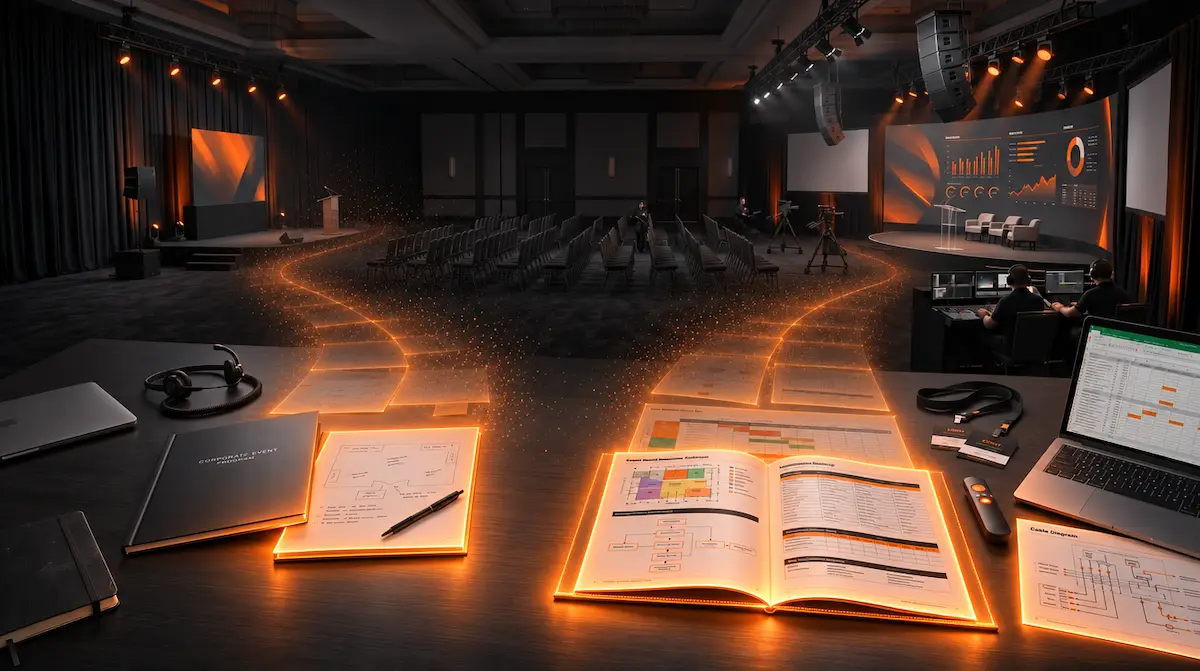
Two event production proposals can be thousands of dollars apart and still appear to describe the same event.
Both may include audio.
Both may include screens.
Both may include cameras, technicians, and presentation support.
So why is one significantly more expensive?
The answer is often in the details.
You do not need to be an AV expert to evaluate a production proposal.
But you do need to understand what is actually included, what assumptions were made, and what may still become an additional cost later.
Start With the Scope, Not the Total
The bottom-line price matters.
It should not be the first thing you compare.
Start by making sure the proposals are actually solving the same problem.
One company may recommend two projection screens while another proposes an LED wall.
One may include a dedicated presentation operator while another assumes another technician will also manage slides.
One may include rehearsal time, recording, backup equipment, and pre-production planning while another primarily lists equipment and show-day labor.
Those are not simply pricing differences.
They may be completely different production approaches.
Before comparing totals, ask:
Are these proposals actually providing the same event?
Look at Labor Carefully
Labor is one of the easiest areas to misunderstand.
A proposal might include roles such as:
- audio engineer
- video engineer
- presentation or graphics operator
- camera operator
- stage manager
- technical director
- utility technician
- teleprompter operator
The number of technicians matters, but so does the amount of time they are scheduled.
Look for:
- setup or load-in
- rehearsal
- show hours
- strike
- travel
- overtime assumptions
A quote that appears less expensive may simply assume fewer technicians or fewer hours.
That could be appropriate.
Or it could mean additional labor will be needed once the production schedule is fully understood.
The important thing is knowing which one you are looking at.
Understand What the Equipment Is Supposed to Do
A long equipment list can look impressive without telling the planner very much.
Instead of trying to understand every model number, focus on what each major system is intended to accomplish.
For example:
Displays: Can the audience comfortably see the presentation?
Audio: Are there enough microphones and appropriate coverage for presenters, panels, and audience interaction?
Cameras: Are they supporting recording, livestreaming, image magnification, or some combination of those?
Presentation system: Who is managing slides, videos, and last-minute presentation changes?
Recording: What is actually being recorded, and what files will be delivered afterward?
A good proposal should make the overall production approach understandable even if the client does not know what every piece of equipment is called.
Check What Is Not Included
Sometimes the most important part of a proposal is what is not there.
Services that may be provided separately can include:
- venue internet
- electrical service
- rigging
- venue labor
- union labor
- staging
- scenic elements
- freight or delivery
- travel
- parking
- power distribution
- additional rehearsal time
- content creation
- captioning
- recording deliverables
These exclusions are not automatically a problem.
Some services may need to come from the venue or another provider.
The important part is knowing about them before the budget is considered complete.
Our guide to 10 AV Questions to Ask a Venue Before Signing the Contract can help identify production costs and requirements that may sit outside the production company's proposal.
Pay Attention to Rehearsal and Pre-Production
The equipment may only be onsite for a few days.
The planning starts much earlier.
Look for whether the proposal accounts for work such as:
- technical planning
- venue coordination
- production meetings
- run-of-show development
- presentation preparation
- presenter requirements
- technical rehearsal
- livestream testing
- show-file preparation
Not every production company bills or displays these services the same way.
Some include them within a project or production fee.
Others list them separately.
What matters is whether the work is actually part of the plan.
A technically complex event should not first become complex when the crew arrives onsite.
As we discuss in Why Event Production Planning Should Start Before the Contract Is Signed, identifying requirements earlier usually gives the team more options and fewer surprises.
Look for the Assumptions
Most proposals are built around assumptions.
Maybe the crew expects access to the ballroom at 8:00 a.m.
Maybe the venue is expected to provide internet.
Maybe presentations are expected to arrive in advance.
Maybe the event is scheduled to finish by 5:00 p.m.
Maybe staging, power, or rigging is being supplied by someone else.
Those assumptions can affect the price significantly.
If the assumptions change, the scope or cost may change too.
That is why they should be discussed before the proposal is approved.
Ask About Backup Planning
Not every piece of equipment needs an identical duplicate sitting beside it.
Critical parts of the production should, however, have a recovery plan.
Ask what happens if:
- a presentation computer fails
- a microphone stops working
- a playback device has a problem
- the livestream connection drops
- a critical cable or signal path fails
The answer might involve backup equipment.
It might involve redundant signal paths.
It might involve a clearly defined recovery procedure.
The right solution depends on the event.
What matters is that the conversation happened before show day.
For more on that planning philosophy, see Why Backup Plans Matter in Professional Event Production.
Optional Items Should Actually Be Optional
Many proposals include alternates or upgrades.
That can be useful.
You might see options for:
- an additional camera
- event recording
- teleprompting
- additional lighting
- upgraded displays
- audience microphones
- livestreaming
- additional rehearsal time
The proposal should make it reasonably clear what changes if those items are removed.
If something labeled as optional is actually necessary for the event to work as described, it probably should not be treated like a simple upgrade.
When Two Quotes Are Very Different, Ask Why
Different production companies may approach the same event differently.
That is not necessarily a problem.
One team may use projection while another believes LED is better suited to the room.
One may staff the event more heavily.
Another may design a simpler production with fewer operators.
One may include rehearsal, recording, backup systems, and pre-production within the initial price.
The other may offer those separately.
If one proposal is significantly higher or lower than another, ask each company to explain the production approach.
You may discover that the more expensive quote includes work or services missing from the lower one.
You may also discover that the higher proposal contains equipment or services that do not meaningfully improve your event.
That is why the comparison should focus on scope rather than simply price.
Understand Who Owns What
Another useful question is:
Who is responsible for making sure each part of the production actually happens?
The production company may own some responsibilities.
The venue may own others.
The planner, agency, streaming provider, scenic company, or client IT team may also have responsibilities.
A proposal should help clarify those boundaries.
For example, saying "internet provided by client" is very different from saying the production company is coordinating directly with venue IT, testing the connection, and incorporating it into the livestream plan.
Both arrangements can work.
They are simply different levels of responsibility.
Clear ownership prevents everyone from discovering onsite that they thought someone else was handling something.
A Good Proposal Should Be Understandable
A production proposal should not test how much AV terminology the planner knows.
It should help everyone agree on what is being delivered.
You should be able to understand:
- what the audience will experience
- what the production team is responsible for
- what the venue or client is responsible for
- what labor is included
- what major services are excluded
- what assumptions affect the price
- what optional items can be added or removed
- what happens if the scope changes
If those things are clear, the equipment list becomes much easier to evaluate.
At Outta Time Productions, we believe the proposal should reflect the production plan, not simply a collection of equipment.
That means understanding the event first, identifying the technical requirements, coordinating the pieces that affect production, and building a scope around what the event actually needs.
Whether you are planning a live corporate event, a hybrid production, or an event that also needs corporate video production, you should not have to become an AV expert to understand what you are approving.
Your production partner should be able to explain it.
The best production proposal is not necessarily the cheapest or the longest. It is the one that makes the scope, responsibilities, and expectations clear before show day.